In Mount Lebanon, coexistence isn't measured by slogans, but by small details told every day without fanfare. From a door open to the neighbors, to a hand extended in a moment of sorrow, to a fleeting greeting on a road where everyone knows their faces. Here, people don't ask first, "Who are you?" but "How are you?"
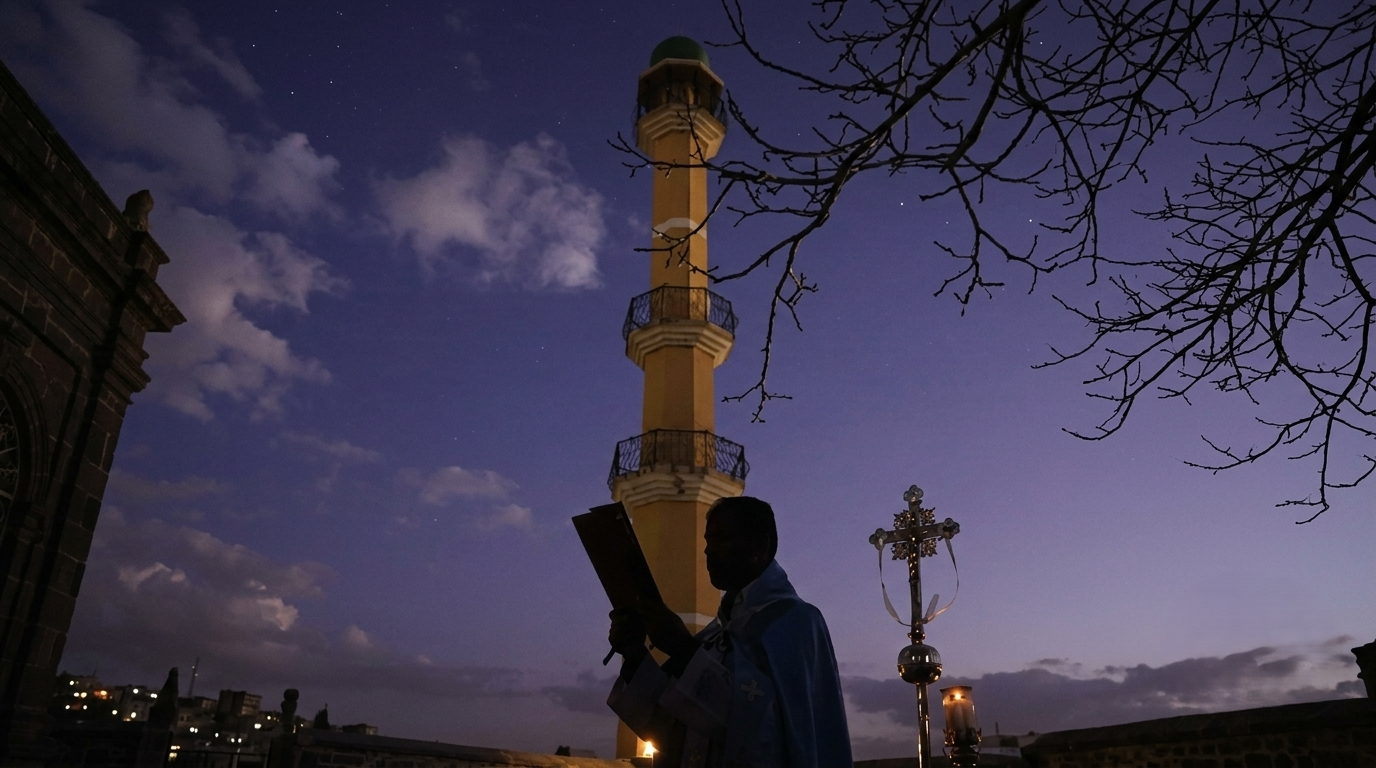
In these intertwined villages and towns, life intersects between the call to prayer rising from a mosque and the ringing of a church bell, neither drowning out the other. They grow together in the collective memory of the place, just as its inhabitants grow up with a simple idea: that difference does not negate closeness, but rather defines it.
Living together here isn't a perfect story, but a daily experience tested in times of crisis—even before ordinary days. In war, in illness, in economic hardship, when all other major issues fade away, humanity remains the most prominent theme. Neighbors stand by their neighbors, not because they are alike, but because they share the same land.
What is really happening in the Mount Lebanon region, specifically in the villages of Keserwan and Jbeil, where homes of diverse religious sects stand side by side, and mosques embrace churches in a single, indivisible tableau? In an investigative journey through these villages and towns, the stories of the people bear witness that the Lebanese fabric, despite all attempts to tear it apart, remains held together by threads of daily love, shared humanity, and a common destiny forged by history and shaped by the present moment. These are stories that tell how religion transforms from a sword of division into a bridge of unity, how social institutions become testaments to a humanity that transcends affiliations, and how life, in all its simplicity, triumphs over the logic of wars and divisions.
Before delving into the details of daily life and how people practice coexistence in Mount Lebanon, it is essential to consider the spiritual and intellectual roots that nourish this reality. What is happening on the ground in Zaytoun, Maaysara, and Jbeil is not a coincidence, but rather an extension of deeply rooted religious teachings that explicitly call for coexistence, mutual understanding, and love, and whose discourse transcends sectarian boundaries to embrace broader human horizons.
In a quiet corner of the town of Al-Hussain in the Keserwan district, Sheikh Mahdi Shams, the town's imam, opens his heart and his holy book to explain the divine dimension of this shared life. He cites a Quranic verse that he considers the foundational document of human coexistence: "In the name of God, the Most Gracious, the Most Merciful. O mankind, indeed We have created you from male and female and made you peoples and tribes that you may know one another. Indeed, the most noble of you in the sight of God is the most righteous of you." Sheikh Mahdi elaborates on the profound meaning of this verse: "Of course, with this noble verse, God Almighty has made mutual understanding the motto. At the beginning of the Quranic verse, God Almighty says 'O mankind,' not 'O believers,' or 'O Muslims.' He doesn't mention any specific religion or group of people, but rather all people."He adds, explaining that the speech is "directed to the world, whether Muslim or non-Muslim," and that the common human root is the basis: "O mankind, indeed We created you from male and female, from the Prophet Adam, all of humanity goes back to the Prophet Adam."
This comprehensive humanistic vision, which places mutual understanding and cooperation as the goal of creation, is the foundation upon which a tolerant Islamic vision is built. This vision does not see religious diversity as a flaw or deficiency, but rather as a divinely ordained richness and wisdom aimed at cooperation and mutual support. "A society is always one where there is cooperation, mutual support, and mutual assistance; it is always a righteous society," Sheikh Mahdi affirms, concluding his remarks by stating that the verse "tells people that you are one community before God; there is no pride among you, no lineage superior to another, no leadership superior to another, and no group superior to another."
A few miles away, at the Jaafari Mufti's office in Jbeil, Dr. Sheikh Muhammad Haidar, Assistant Mufti of Jbeil and Kesrouan, encounters this vision from another angle, adding a new dimension: the dimension of interpretation and intellectual diversity within a single school of thought, and how this very diversity forms fertile ground for encountering the other. Sheikh Haidar defines Shi'ism as, in its essence, a school of "interpretation" that deals with the text with flexibility and understanding of the circumstances of time and place. He describes it as fundamentally "a beautiful idea": "I dedicate myself to a different embrace... I always say I dedicate myself to a different embrace because I am convinced of the value of difference, for difference is rich (from the word 'richness' meaning abundance), and backwardness is evil. I am fully convinced that the most beautiful, pristine painting cannot be of a single color; rather, colors must blend together."
That vibrant tableau that Sheikh Haidar speaks of is Lebanon itself, or more precisely, the idea of "different embraces," which he sees as a magical solution to the challenges of pluralism. He gives the example of a painting whose beauty is only complete through the interplay of different colors, provided there is harmony and consonance. This concept extends to his view of religion itself: "I always say that if we gave Picasso a thousand colors starting from a single one, he wouldn't have been able to create his most beautiful painting. And if we gave Al-Mutanabbi a thousand voices of the same nature, he wouldn't have been able to produce his most vibrant poem. The secret of creativity is always difference and unity."
In the church of Zaytoun in the Keserwan district, a church that stands proudly beside the mosque, forming a unique tableau of architectural and spiritual coexistence, Father Elie Keyrouz picks up the thread of love from where Sheikh Haidar left off, but adds a profound Christian dimension: the dimension of sacrifice and redemption. Father Elie explains that Jesus Christ did not merely command, "Love one another," but raised the bar even higher: "As I have loved you."
He asks, "How did Jesus love us? He died for us. When humanity comes to know one another, draws closer, and is willing to die for one another, the peace for which Jesus came will prevail." Love here is not just an emotion or words, but an existential act, a sacrifice, an initiative to reach out to others, even to the point of "dying" for them that is, exerting effort and giving to the utmost extent to build the peace that is the essence of Christ's message.
This profound religious vision, combining the verse "that you may know one another" and the commandment "love one another," is the spiritual foundation upon which the edifice of daily coexistence in the villages of Mount Lebanon is built. It is not merely intellectual theory, but fertile ground from which the seeds of love and tolerance sprout daily, seeds we see embodied in community initiatives, service institutions, and even in the simplest details of daily life.
Before there are sects, there are villages, and before there are religious affiliations, there is neighborliness and shared living. This is the lesson offered by the town of Zaytoun in the Keserwan district, a unique town whose mayor, Maroun Fahd, says, "It's the only village that's half Shia and half Christian." In Zaytoun, the sectarian distribution isn't just cold numbers; it's a daily reality. "When we talk about coexistence, my heart swells when I go to a Christian funeral and meet a Shia who's come to offer condolences, and vice versa. My heart swells when I see a church next to a mosque," says Maroun Fahd, describing a scene that repeats itself on every occasion.
But the most beautiful story is how religious occasions transform into opportunities for meeting and sharing, and how wheat and the road become symbols of a unity that transcends sectarianism. The mayor recounts the story of a simple initiative that carried profound meaning: "In our village of Barbara, we came up with the idea of boiling wheat and distributing it to the entire village. This is a Christian occasion, but the Shiite community participated the most; it was the Shiite youth who were distributing it."
Conversely, with the arrival of Ashura, a solemn occasion for Shiites, the exact opposite occurs. Maroun Fahd recounts another scene brimming with humanity: "During Ashura, the young men and women of the village offer hospitality along the way, and there are lamentations. If you want, I personally make a point of going back and forth, to offer hospitality, to see the smiles on their faces." This is not merely an exchange of visits, but a transformation of religious occasions into a collective ritual of joy and sharing, turning the boiled wheat of Saint Barbara's Day into a meal for everyone, and transforming the Ashura mourning procession into a path of unity that brings everyone together in the heart of the town.
Coexistence isn't just a slogan; it's a way of life. It's a daily practice, starting with boiling wheat and ending with distributing food in the name of the Prophet's family, and it permeates every aspect of life. As Maroun Fahd says, speaking candidly about his municipal work: "There's a fundamental point here, which is municipal work in this particular village. It's a very sensitive village. I mean, if I come to prepare for an event think it's Christmas I'm afraid I won't be able to do the same for Shia occasions."
This "fear" of falling short in my duty to others isn't a fear of criticism or reproach, but rather a deep sense of moral responsibility towards neighbors, towards partners in the homeland and in destiny.
From Zaytoun, we move to the school that prepares future generations on this approach to coexistence, where it plants in the students' souls the seeds of tolerance and knowledge of others from a young age, and makes difference a source of enrichment and learning instead of a cause of fear and isolation.
Educational institutions in the Mount Lebanon region are not merely places for acquiring knowledge, but rather veritable laboratories for building a cohesive society. At the Al-Maaysrah Public High School, under the leadership of Mr. Hamid Haidar, who has served in this position for 11 years, a unique experiment was implemented: integrating religious education and diversifying the teaching staff. Mr. Hamid explains: "In the 2008-2009 academic year, we came up with the idea of integrating religious education and diversifying the teaching staff. This means that the Islamic religious education teacher would teach a class of Christian students, giving them an introduction to Islam, and the priest would teach a class of Christian religious education, or the lesson would be given to Muslim students."
This idea, which began in 2008, as Professor Hamid recalls, aimed at two main objectives: "Introducing others to religions and trying to bridge the gap so that people would stop fearing the other." The deeper goal was "to familiarize students with the other side, so they would stop fearing it, and to help them understand the meaning of religion." The religious classes in Ma'isara were not merely theoretical lessons about other beliefs, but rather a bridge for getting to know one another and debunking misconceptions: "The topics were general, such as the concept of God in Islam and Christianity, and about equality, love, brotherhood, and getting to know the other."
As a culmination of these efforts, Professor Hamid points out that the students themselves have become part of this awareness-raising process: "To the point that after a few stages, the students themselves started asking us to continue with this topic," meaning that the students began asking the professors to continue these awareness-raising lessons, which indicates the success of the idea in changing the perception of religion and others, moving it from a state of fear and ignorance to a state of curiosity and knowledge, and then to a state of acceptance and natural coexistence.
The most important test for any society that promotes coexistence is how it treats its most vulnerable and needy members, and the extent to which it transcends sectarian affiliations to provide basic humanitarian services. At the Health Authority clinic in Jbeil, we found another example of this coexistence, which has become a daily practice. Batoul Hallani, a nurse at the clinic, testifies to this tangible reality: "Patients come to us from different regions and sects, including Christian patients, and they receive treatment here just like any other patient. For us, the patient is first and foremost a human being in need of care, and we don't ask about their sect when they need help."
Not only that, but she adds: "There are also Christian doctors working at the clinic."
In this intimate human space, differences melt away, classifications fade, and only humanity remains with its pain and needs: "The patient comes, the doctor treats them, and we, as nurses, are by their side, each fulfilling our role regardless of religious affiliation. Ultimately, health and humanity transcend sectarianism, and we witness this daily at the clinic."
With this astonishing simplicity, healthcare becomes a microcosm of coexistence, where questions of belonging are irrelevant, and the most important and humane question remains: "How can we help you?"
This human experience expands to include other institutions and initiatives, where economic aid and services become new facets of this shared life, and social institutions that provide financial services become platforms for trust and cooperation that transcend all sectarian boundaries.
Engineer Sanaa Shehab, a resident of Jbeil, recounts her experience with the Health Authority clinic, and how she went from being just a patient in need of medication to a witness to a humanity that transcends all classifications. Sanaa says, with sincerity and emotion, "When the medicine crisis hit, and the revolution happened, and the dollar exchange rate fluctuated, there were medications we couldn't even afford. My friends from Amchit directed me to the Health Authority clinic in the Jbeil area. I went and dealt with them. And truly, I can only speak from the bottom of my heart. They are like sisters, the best of people, truly humane."Her testimony doesn't stop at her personal experience, but goes beyond it to tell another human story, the story of a young man who worked with her, who faced a health crisis with his son. "His son had colon cancer, and he reached a point where he couldn't afford the injections. But when I found out that the injections were available here, I directed him to the clinic, and he was able to get them," she added, describing the treatment: "The treatment was very good, I can't say more than that. Honestly, I'm Lebanese, that's all I can say."
Amid Lebanon's crippling economic crisis, social institutions and initiatives have emerged, forming a safety net for citizens and transcending sectarian affiliations to reach broader humanitarian horizons. The "Al-Qard Al-Hasan" Association, founded in 1987 as a charitable and social organization offering interest-free loans, has become a social and economic phenomenon, its influence extending far beyond the Shia community in which it originated. Rabih Majed, director of the association's Jbeil branch, describes the phenomenon: "Through my experience at the branch, I've witnessed many situations that demonstrate how people's interactions have nothing to do with their sect."For example, at least one Christian person comes almost every day to ask if it's possible to get a loan, or sometimes he comes with his Christian friends to ask about loans and benefit from them. This is normal for us, because the institution deals with people based on their needs, not on their religious affiliation.
Perhaps the most recent crisis, the 2024 war and the subsequent security crackdown and tightened measures, posed the association's toughest test. Rabih Majed describes the magnitude of the challenge: "During the 2024 war, with the security crackdown and the accompanying measures, in addition to the closure of some institutions and the pressures related to the banking sector and the Governor of the Central Bank of Lebanon, we experienced a very difficult period. Twenty-seven branches were even buried under rubble, yet we managed to reopen and resume operations the day after the ceasefire." He continues, "During this crisis specifically, the demand for loans increased by about 50 to 60%." This significant increase in demand is not only due to dire need, but also reflects the great trust that people, regardless of their affiliations, have placed in this institution, which has become more than just a lender; it has become a symbol of social solidarity in times of hardship.
The story of Elie Najm, a Christian citizen from Bcharre, dramatically embodies this trust. Elie recounts his experience with the association: "About a while ago, about a year and a half, I was facing financial hardship and everything seemed to be closing in on me. We knocked on every door, wondering how we could manage our affairs, who would help us, what we could do. I have a friend, one of our Shia brothers in the area we live together in Jbeil who told me, 'We have an interest-free loan; you need to pledge something, gold or whatever, and it will work.'"
In a scene that encapsulates all the meanings of trust and compromise, Elie describes how the transaction was handled smoothly and respectfully: "I was at the interest-free loan office at 9:30, and by 10:30, I had the money with me."No one asked what my sect was. Christian? Muslim? Druze? Where are you from? All they asked for was my ID and the money, and how I was going to pay it back. Elie concludes his testimony by emphasizing the most important aspect of this experience: "And the most important thing is that all of them together, I swear to God, it was completely useless." This testimony not only reflects a personal experience but also reveals a broader social phenomenon, where economic need becomes a bridge of trust and cooperation between members of different sects, and a social institution with a specific religious background becomes a source of support for everyone in times of hardship.
In another alley in Kesrouan, we meet Ali Ahmad, who shares his experience. Ali begins by talking about the mixed environment he grew up in: "Since our whole area is mixed, with Muslims and Christians, I have Christian friends from school and work. They participate in our celebrations, and we participate in theirs. I go to their events."
He gives a vivid example of Ashura: "Just recently, during Muharram, several of my friends came to observe Ashura with us. For example, if I have a death or something, I go and attend their events." He adds, "We celebrate their holidays, and they come to celebrate ours."
Ali concludes his remarks with a simple yet profound expression that encapsulates the essence of true coexistence: "We live as one." This sense of unity, despite our diverse affiliations, is what every Lebanese person seeks, and it is what makes these mountain villages a model of coexistence, not only in Lebanon but in all diverse societies searching for a formula to live together in peace.
Nour Nassif shares this perspective from another angle, focusing on her personal experience with doctors and healthcare services: "Personally, I have an experience that reflects this. I'm treated by a Christian doctor, and honestly, he's very good to me. He treats me with respect and care. The doctor is very cooperative; he doesn't differentiate between me and other patients, even though they are Christian. On the contrary, he adheres to appointments exactly as scheduled, without delay." She adds that this experience extended to times of crisis, where professional ethics and humanity shone through: "During the war, during the displacement, he offered almost free checkups—about 80% off for everyone displaced. Even the clinic offered free checkups for Muslims.Nour concludes by emphasizing that diversity in Mount Lebanon is not a flaw but a strength: “In my opinion, this is the true meaning of coexistence. It means we can be different in religion or belief, but we still respect each other, help each other, and live together in love. Mount Lebanon has a lot of diversity, and this diversity shouldn't be a cause for conflict; on the contrary, it can be a source of strength and richness for the community.”
Hanaa Youssef joins this collective voice, affirming that coexistence is not merely superficial relationships, but rather a daily life lived in its small details. "I lived in a mixed area and I never felt that the difference in religion was a barrier between me and the people. On the contrary, there was always good treatment and respect, and we got to know each other and shared the details of our lives.She gives an example of genuine sharing in good times and bad: “For instance, when there was a funeral (a Christian burial ceremony) at the home of our Christian neighbors, we would go and share in the grief of the bereaved family and stand by them, and they would stand by us in difficult times and occasions. This, for me, was proof that the relationship wasn't just a neighborly one; it became a truly human relationship.” Hanaa concludes by emphasizing that this coexistence is a way of life that reflects the reality of the Mount Lebanon region: “And for me, this is the true meaning of coexistence: to see the other person as a human being before considering their religious affiliation.”
Charbel Daniel recounts his personal experience with his Shia neighbors, from childhood to the present day. He says, "I was born and raised in a mixed area. From the moment I became aware of the world, I had Shia and Christian neighbors in the same neighborhood, and there were no barriers between us. We used to play together in the street, sometimes go to the same school, and then go on with our day completely normally.He adds that the concept of "difference" was never an obstacle in his daily life. "We never asked each other what sect or religion you were. What mattered was how we treated each other, how we lived together. Even during holidays, we shared with each other. During Ashura, we would go and see the processions, and sometimes we would help or stand with our friends, and at the same time, they would visit us during Christian holidays." Charbel points out that this relationship was not limited to childhood, but continued into his youth and work. "Today, I have Shiite friends from work and university."We go out together, we work together, and if they have an event, I go, and if I have an event, they come. The relationship has become more than just a matter of religion; it's become a relationship of trust and friendship. Regarding the difficult moments that Lebanon has gone through, Charbel says that crises often revealed the depth of this bond. "During the war or economic crises, no one asked who was with whom. We helped each other in any way we could. If someone needed medicine or support, everyone stood by everyone else, regardless of anything else."
Charbel concludes his remarks with a personal perspective on the concept of coexistence: “In my opinion, coexistence is not a slogan or media rhetoric. It is daily life. It is considering your neighbor as part of your life, not a stranger to you. In Mount Lebanon, we don’t just live together, we live as if we are one big family, despite all our differences.”
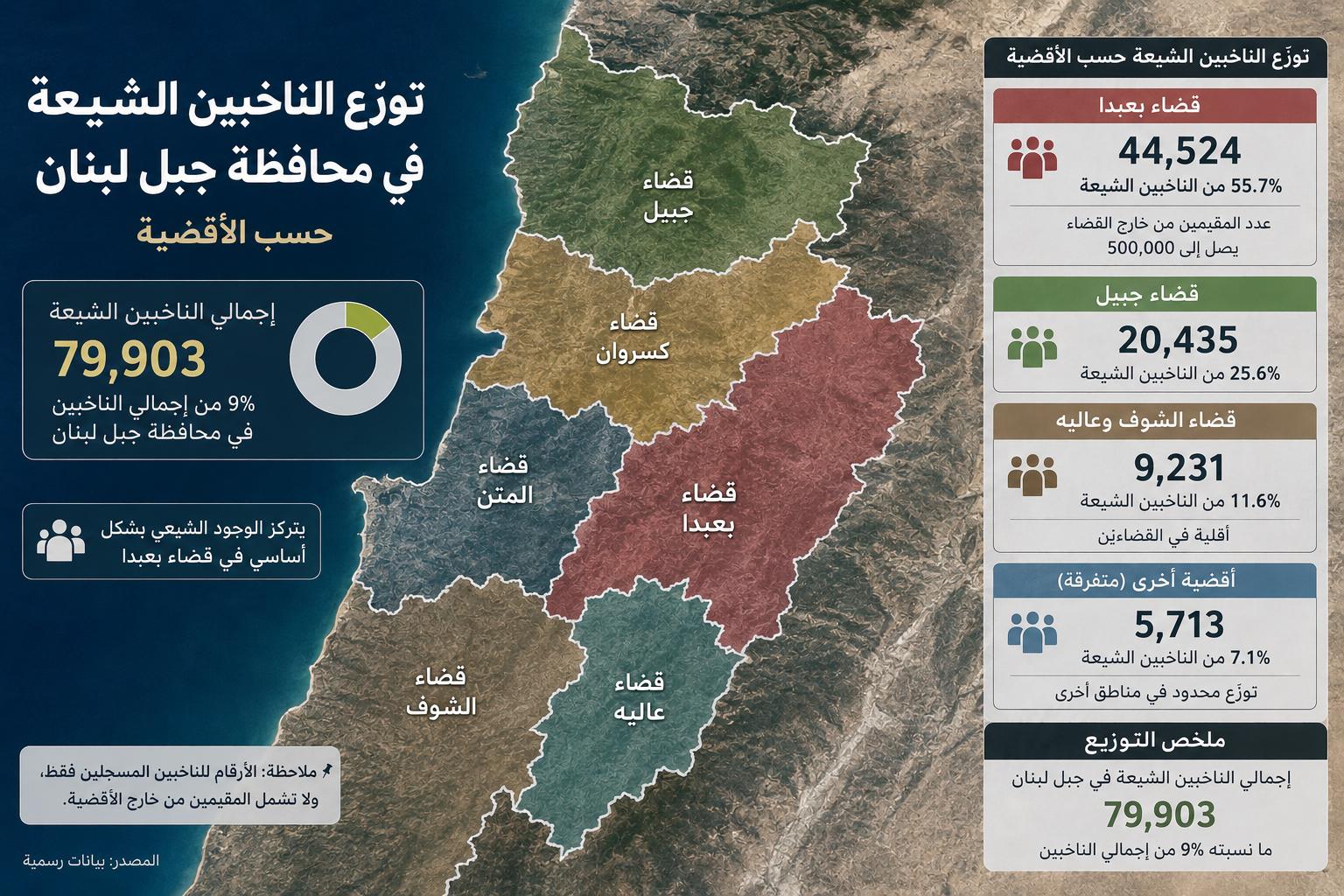
The data related to the electoral lists in Mount Lebanon Governorate clearly reveals the demographic structure that forms the general framework for coexistence in the region. The number of voters in the governorate is approximately 883,768, including 546,143 Christian voters, representing about 62% of the total electorate, compared to approximately 79,903 Shiite voters, or about 9%. This distribution should not be interpreted merely as static figures, but rather as a social map reflecting the nature of the demographic intermingling within each district. The Shiite presence is primarily concentrated in the Baabda district with approximately 44,524 voters, alongside a smaller presence in Jbeil with about 20,435 voters, and even smaller minorities in the Chouf and Aley districts, estimated at around 9,231 voters.However, these figures alone do not reflect the actual size of the presence on the ground, as local data indicates the presence of approximately 500,000 residents in the Baabda district alone, reflecting a population density and social intermingling that goes beyond the narrow electoral dimension, confirming that Mount Lebanon is not merely a matter of sectarian or electoral divisions, but rather a shared living space where sects intersect within the same geography and reproduce their daily relationships outside the logic of numbers.
On this ancient mountain, where the mist of winter embraces the breeze of summer,
and the sounds of the call to prayer mingle with the echoes of prayers, and where the Church of Zeitoun stands beside its mosque in
a single scene that encapsulates much, coexistence does not appear to be a slogan to be raised, but a reality to be lived.
Thus, Mount Lebanon emerges as a space that transcends division, becoming a daily model of coexistence based not on idealism but on continuity. Here, diversity is not an anomaly, but rather an integral part of life itself, where different people coexist within a single equation whose simplest tenet is that humanity precedes identity. This simple truth, lived by the people of Mount Lebanon every day, is what makes this region a unique model in a world that is becoming increasingly polarized and extremist.
At the end of this extended scene, the question is no longer about the possibility of coexistence, but rather about the secret of its continuation despite all the surrounding crises. Perhaps the answer lies in these very details: in a daily life built in silence, yet speaking volumes. It is a secret that is both simple and profound: humanity before belonging, sharing before conflict, and love above all else.
Perhaps coexistence in Mount Lebanon can't be summed up in a slogan, but rather in a simpler, yet more profound, question: How can different people continue to live together, despite everything?
The answer, as these stories show, lies not in focusing on the differences, but in continuing to live with them, in complete humanity.
Perhaps the most important question that this reality poses to every Lebanese person, and to every person in this world, is: If the people of Mount Lebanon can live together with this love and solidarity despite all their differences, what prevents the rest of the world from doing the same?
Mount Lebanon, with its churches and mosques, its Christians and Shiites, writes a story of hope for all humanity every day, in the simplest details of life. A story that promises that despite all wars and crises, humanity can triumph over sectarianism, build bridges of love and understanding, and create from its diversity a mosaic adorned by life and unbroken by wars. In this rare human scene, the hidden secret of Lebanon's survival despite all challenges is revealed a secret that is both simple and profound: humanity before affiliation, participation before discord, and love above all else.